







 Back to blog home
Post the industrial revolution, logistics has become more than just an operation of delivering products from point A to B. Add to it the fast paced and globalized world, logistics turns out to become one of the most game changing operations for most businesses.
In a world where speed and precision matters; delivery systems have transitioned from good old mail service to same day deliveries and even 10 minute deliveries! This is enabled by the ever-growing sophistication of the logistics industry.
Now today’s scenario, where large scale logistical operations have taken center stage, the systems and processes running these operations too, need technologies that can supercharge them. This ability has come in the form of AI in logistics.
An industry that has always been driven by numbers, data and forecast based predictions; now has access to a technology that can make it easier to better manage the scale and agility that is demanded off the logistics industry.
How is AI enabling the logistics industry? Well, imagine it as an always-on assistant that sifts through massive datasets, recognizes patterns, and provides insights to make decisions and streamline operations, while also identifying and predicting risks in supply chains of the customers that it serves.
Just like AI in insurance analyzes policies, detects fraud, and predicts claims trends, AI in logistics improves efficiency, reduces costs, and enhances customer satisfaction by making smarter, faster decisions.
As a result, it is helping logistics companies cut fuel costs, predict risks within complex supply chains, forecast stock demand and supply and work smarter, faster, and with greater precision than ever before.
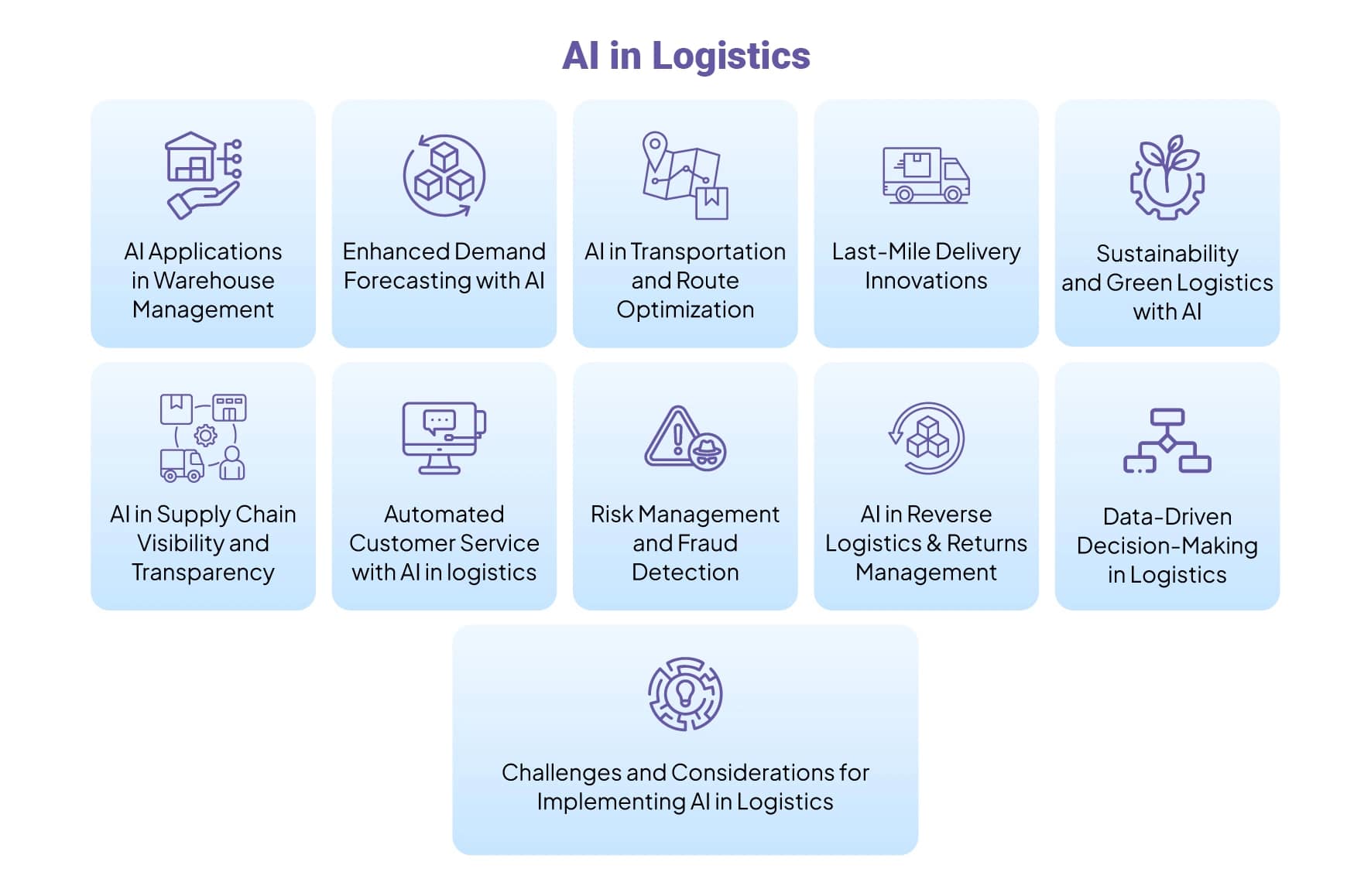
Let’s look at 11 real-world ways artificial intelligence in logistics is bringing transformational change to the industry.
1. AI Applications in Warehouse Management
A warehouse is in logistics, what an engine is in a car. Every activity that takes place in a logistical operation, either begins or ends at a warehouse. A warehouse is always a buzz with goods coming in, going out, packed or being stored.
AI in logistics combined with robotics, has the capability to make all of these processes automated; as well as in sync with each other seamlessly. AI systems can analyze sales data, predict demand, and manage stock levels to avoid both shortages and overstock situations.
Instead of staff counting items by hand, AI-enabled sensors and tracking systems keep count automatically and even alert managers when restocking is needed.
Picking and sorting processes can also be automated by deploying robots that travel through the aisles and pick up the products required to fulfil the orders. Human intervention is brought to the minimum with this process. This isn’t just a futuristic concept anymore. It is a process well and truly being used by many ecommerce giants.
The complete layout of the warehouse can also be optimized by the use of AI in logistics. The algorithms can suggest the products that need to be placed closer to the loading dock based on their demand and seasonality.
It can do so by analysing the movement patterns, order frequency etc.
2. Enhanced Demand Forecasting with AI
As much as logistics is science, it is also an art. Traditionally, experts would forecast demand based on historical data. However, with the integration of AI in logistics, they can take it a step further with predictive demand analysis. This can be achieved through a mix of historical data, market trends, economic indicators and by also including social media tags and engagement data.
In the instance of seasonal forecasting, during vacations or even unexpected events, AI is armed to deal with booms in demand and ensure that the business isn’t caught by surprise. By doing so, the business can adjust all other factors such as workforce, schedules, inventories etc in order to ensure that they neither face a stockout nor an excess of inventory.
3. AI in Transportation and Route Optimization
It is impossible to talk about logistics, without talking about transportation. Thus, if we talk about AI in logistics; the conversation would be incomplete without talking about how AI optimizes transportations.
AI algorithms account for internal as well as external factors such as traffic, weather, road closures etc. to suggest the optimal and the fastest routes possible. It can also be designed to suggest the most fuel efficient routes. A truck for instance can be diverted to a better route if AI detects an accident or a mishap on a certain route.
Apart from saving travel times, AI is also equipped to analyse vehicle health and detect wear and tear based on its driving patterns. This not only reduces the downtime on the vehicle but also improves the vehicles lifespan and lowers overall maintenance cost.
4. Last-Mile Delivery Innovations
The “Last mile†refers to the part of transportation when the vehicle has reached close to the end destination; which is most often within a dense part of a city/town. This is considered tricky because a small diversion/detour can lead to long delays and even huge costs in some cases.
To negate this, some companies are experimenting with autonomous vehicles such as drones, for this last mile delivery. This is made possible by the integration of AI in logistics.
It is also capable of accommodating personal preferences in case of deliveries to consumers. AI can allow the company to offer a more tailored service by analysing the consumer’s schedules and preferences. This boosts customer satisfaction and also reduces the chances of missed deliveries.
5. AI in Supply Chain Visibility and Transparency
For logistics managers, visibility and transparency is paramount when the shipment is travelling across various touchpoints. AI allows end to end visibility and also flags any delays. For instance, a medical supply van can be re-routed if it is likely to encounter traffic or diversions on its original route.
AI in logistics can also act as a regulator when combined with blockchain transactions. Block chain provides a secure payment gateway while AI analyses any weak links or fraudulent/anomalous activity throughout the supply chain.
6. Automated Customer Service with AI in logistics
The logistics industry is always challenged with providing improved customer service. Customers expect real-time tracking and updates on the movement of their packages. AI in logistics can allow businesses to answer all these questions and more, by setting up tracking updates as well as chat bots that resolve general enquiries.
Additionally, as established earlier, AI can be a great tool for predictive analysis and proactive measures. A customer’s buying patterns can be observed over a period of time and they can be provided customized suggestions there on.
7. Risk Management and Fraud Detection
Risk is a part of business, and logistics is no different in that sense.
Internal factors like stockouts, pilferage etc. coupled with external factors such as weather, natural disasters, political instability etc. make up some of the major risks in the industry.
AI in logistics can negate such threat factors and flag them in advance, for operations personnel to consider alternatives.
Fraud detection is another area where AI shines. In industries with high-value shipments, fraudulent activities are not uncommon. AI analyses transaction and shipment data for anomalies, helping detect and prevent fraud early in the logistics process.
AI can detect any discrepancy or anomalies and help prevent the business from incurring huge losses.
8. AI in Reverse Logistics and Returns Management
The advent of ecommerce has given rise to a new aspect in logistics: returns. Providing a smooth return process can really make a business stand out from competition; but can be equally tricky to handle.
AI in logistics can speed up the return process by verifying the order details and eligibility and initiate a refund if needed.
Predictive analysis can help businesses be prepared for items that are facing frequent returns and identify what is causing it.
9. Sustainability and Green Logistics with AI
Transportation is at the heart of logistics. This brings a lot of responsibility on the shoulders of logistics experts to make sure that their operations are sustainable and eco-friendly.
Optimal use of fuel not only saves cost for the business, but also plays a pivotal role in the business’ efforts to minimize their carbon footprint.
As detailed earlier, AI in logistics can analyse and suggest best routes for cargo ensuring that it has a minimum impact on the environment. Apart from transportation, AI also minimizes overstocking and dead stock. This in turn, reduces the waste and disposal associated with expired and unsold products.
10. Data-Driven Decision-Making in Logistics
AI in logistics has the ability to affect operations from a micro to macro level. From rerouting a truck that could face a potential road closure, to real time decisions that can change the game, AI is capable of it all.
The best part is that it does not treat the micro and macro as two parallels; it brings them together in sync and provides the experts with a holistic view of the operations.
11. Challenges and Considerations for Implementing AI in Logistics
As much as AI can boost a logistics business’ performance, it also comes at a cost. Smaller businesses need to be wary of this cost and need a strategic approach to attain this superpower.
With great power however, also comes great responsibility. AI in logistics can render a great deal of power in the hands of personnel, in the form of consumer data.It is thus obligatory for them to wield this data wisely and in a secure manner. AI may automate most processes but human intervention at certain points is still as important as ever, in order to maintain checks and balances between man and machine.
Real-World Examples and Case Studies of AI in Logistics
It is no surprise that some of the leading logistics and ecommerce companies have wasted no time in integrating AI in most of their operations.
- Amazon: AI driven robots for picking up and packing shipments
- FedEx: Streamlined route planning
- DHL: AI powered demand forecasting
The not-so-big companies have been able to match their bigger competitors by leveraging cloud-based AI tools, which provides customized and economic AI assistance on a pay-as-you-go basis.
Future of AI in Logistics
As futuristic as AI in logistics seems right now, there is still more promise and a huge deal of emerging technology around the corner.
Powerful AI computing may soon provide businesses with an even greater ability to handle optimization problems and could speed up processes like returns, route planning and inventory management even further.
Furthermore, AI automated infrastructure can make logistical operations even more independent. We could see networks that monitors, diagnoses and resolve their own operations with minimum human intervention.
Conclusion
It is fairly clear, that AI in logistics isn’t just a luxury or an add on. It is more than equipped to improve not just efficiency, but also environmental sustainability and most importantly: customer satisfaction.
When coupled with the right and timely human-in-loop intervention, it can pave the way for smarter and more responsive supply chains that go beyond just meeting the demands of customers.