








 Back to blog home
HPCaaS allows businesses to leverage high-performance computing resources on demand, without the need to invest in expensive hardware or maintain complex infrastructure. It’s like renting a high-end computer whenever you need it, paying only for what you use.
High-Performance Computing (HPC) is the use of really powerful computers— as they are built, to solve complex computational problems. These HPC systems traditionally cost a fortune and require a complex infrastructure. This made it feasible only for large organisations and research centres to afford such systems.
However, the advent of cloud computing has made it a lot easier for small and medium businesses to access HPCs through a model known as High-Performance Computing as a Service (HPCaaS). This model is much more scalable and accessible, apart from being cheaper.
Why is HPCaaS Important in the AI Era?
So, we’ve established that AI needs serious computing muscle. But why is High-Performance Computing as a Service (HPCaaS) becoming such a critical piece of the puzzle in this AI era?
Instead of building, you’re essentially renting access to these powerful computing resources over the cloud.
Here’s why that matters specifically for AI development:
- Access to Power: It lowers the barrier to entry. Companies or research teams that couldn’t afford their own advanced computers can now access top-tier computing power needed for ambitious AI projects.
- Scalability on Demand: AI workloads aren’t constant. Training a massive model might require enormous power for weeks while running the trained model (inference) might need less, or maybe you need to scale inference up rapidly for user demand. HPCaaS lets you dial the resources up or down as needed.
- Cost-Effectiveness: Building your own HPC cluster involves massive upfront capital expenditure (CapEx) – buying all that expensive hardware, plus costs for space, power, and cooling. You pay for it whether it’s running at full capacity or sitting idle. HPCaaS shifts this to an operational expenditure (OpEx) model. You pay primarily for what you consume, avoiding the huge initial investment and the ongoing costs of maintaining potentially underutilized hardware. This makes accessing cutting-edge computing much more financially manageable.
- Faster Development Cycles: Getting access to powerful HPC resources means training models faster. Instead of waiting months, you might wait weeks or days. This speed allows teams to experiment more, iterate faster, and ultimately develop better AI solutions more quickly.
- Focus on AI, Not Infrastructure: Data scientists and AI engineers can concentrate on building and refining models rather than worrying about managing complex hardware. The service provider handles the underlying infrastructure, including updates and maintenance.

How Does HPCaaS Work?
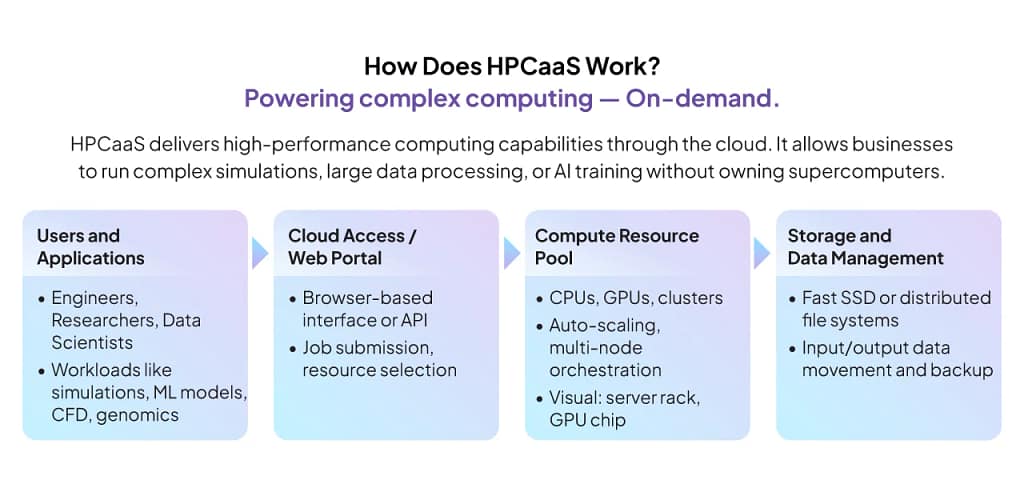
HPCaaS operates on a cloud-based model, where service providers offer HPC resources over the Internet. This is how it works:
- The Provider Sets Up Shop: A provider invests heavily in building and managing the core HPC infrastructure in large data centres. This isn’t your average server rack.
- Compute Nodes: Lots of powerful processors (CPUs) and often a high density of specialised accelerators like GPUs (Graphics Processing Units), which are particularly good at the parallel math AI loves.
- High-Speed Networking: Special connections (like InfiniBand or high-speed Ethernet) let all these processors quickly talk to each other. This is crucial for large AI models where data must constantly zip between nodes.
- Fast Storage: Systems designed to read and write huge datasets rapidly, so the processors aren’t left waiting for data.
- You Connect Remotely: As the user, you don’t need to worry about the physical hardware. You access these resources over the internet or a dedicated network connection, typically through a web portal or command-line tools provided by the HPCaaS vendor.
- Requesting Resources: You don’t just get a generic virtual machine. You typically specify what you need for your job: how many CPU cores, how many GPUs (and often which type), how much memory, storage requirements, etc.
- Resource Allocation: The HPCaaS system’s management software (often called a scheduler or orchestrator) takes your request. It finds the necessary physical resources from its large pool, reserves them for your job, and configures them to work together.
- Running Your Job: Once the resources are allocated, you can deploy your AI workload. This usually involves uploading your code and data (or pointing the system to where it’s stored), and then launching the training or inference process. The computations run on the provider’s powerful hardware.
- Management & Maintenance: Behind the scenes, the provider handles all the upkeep, including hardware maintenance, software updates, power, cooling, and security, and ensures the high-speed network runs smoothly. This is a huge part of the value – you get the power without the operational burden.
- Paying for Usage: When your job is done (or while it’s running), the system tracks the resources you consumed (like GPU hours, CPU hours, data storage, network traffic). Following the provider’s pricing model, you’re then billed based on that usage.
What makes it different?
What makes HPCaaS truly different from just renting standard cloud servers or building your own high-powered setup? It comes down to a few key characteristics tailored for demanding tasks like AI:
- Specialised Hardware Access: HPCaaS isn’t just about offering more computing; it’s about offering the right kind. This typically means easy access to large numbers of cutting-edge GPUs (Graphics Processing Units) or other accelerators that are exceptionally good at the parallel calculations needed for deep learning. You also get powerful CPUs and large amounts of memory, configured specifically for compute-heavy jobs.
- High-Speed Interconnects: Large-scale AI training involves many processors working together and constantly exchanging massive amounts of data. HPCaaS platforms use specialized, very high-bandwidth, low-latency networking (like InfiniBand or advanced Ethernet) to connect the compute nodes. This is fundamentally different from standard cloud networking and absolutely critical for performance.
- Designed for Massive Parallelism: The entire architecture, from the hardware to the network to the file systems, is built with the assumption that you’ll be running jobs across many nodes simultaneously. Standard cloud infrastructure might allow this, but HPCaaS is optimised for it. The schedulers and management tools are designed to handle large, distributed computing tasks efficiently.
- Scalability Tailored for Compute Peaks: While many cloud services scale, HPCaaS focuses on providing the ability to rapidly scale up to very large numbers of specialised compute nodes for a specific period (like a model training run) and then scale back down. This elasticity for high-end computing addresses the bursty, extremely high-demand nature of HPC workloads.
- Pay-as-you-go Pricing Model: With HPCaaS, you typically operate on an operational expenditure (OpEx) basis. You pay for the specific resources (like GPU hours, CPU core hours, storage used) only when you are using them. This model dramatically lowers the financial barrier to entry and aligns costs directly with usage, avoiding payments for idle, expensive hardware.
How HPCaaS help your AI workloads
- Accelerating Model Training: This is often the most immediate and impactful benefit. Training modern deep learning models, especially large ones, on standard hardware can take weeks or even months. HPCaaS provides access to clusters of powerful GPUs connected by high-speed networks, slashing that training time down to days or hours. This speed isn’t just convenient; it’s transformative, allowing you to iterate much faster.
- Enabling Bigger, More Complex Models: Some state-of-the-art AI models are simply too large or computationally intensive to train or even run effectively without HPC-level resources. HPCaaS gives you the scale – the sheer number of coordinated processors and memory – needed to tackle these ambitious projects that would be out of reach with typical infrastructure.
- Facilitating Rapid Experimentation: AI development is inherently experimental. You need to try different architectures, hyperparameters, and datasets. The speed and scalability offered by HPCaaS mean you can run more experiments in parallel or sequentially much faster. This accelerates the discovery process and ultimately leads to better, more refined AI models.
- Making Advanced AI Accessible: Building a dedicated HPC cluster is prohibitively expensive for many organisations. HPCaaS democratises access. Startups, academic researchers, or specific teams within larger companies can tap into world-class computing power without the massive upfront capital investment, levelling the playing field for innovation.
- Optimising Costs for Burst Needs: AI workloads are often “bursty” – you need immense power for training, perhaps less for inference, and maybe periodic bursts for retraining. The pay-as-you-go model of HPCaaS aligns perfectly with this.
Real-World Applications of HPCaaS in AI
HPCaaS is being used across various industries to drive innovation and efficiency. Here are some examples:
1. Healthcare
AI in healthcare has proved to be pivotal in saving millions of lives. It allows medical professionals to make better decisions in real-time. The role of HPCaaS cannot be undermined in this paradigm shift. Some of the very prominent examples are:
- Drug Discovery: HPCaaS accelerates the simulation and analysis of molecular interactions, speeding up the drug discovery process. For example, pharmaceutical companies use HPCaaS to identify potential drug candidates in a fraction of the time.
- Medical Imaging: AI-powered image analysis tools rely on HPCaaS for real-time processing of medical images, enabling faster and more accurate diagnoses.
2. Finance
Synergising AI in insurance, banking, auditing and finance in general has allowed consumers to transact with much more trust and ease of access. The finance sector, more than any other industry needs state-of-the-art computing systems owing to the sheer size of the data.
- Fraud Detection: HPCaaS enables the rapid analysis of large datasets to identify fraudulent transactions. Banks and financial institutions use HPCaaS to detect anomalies in real time, reducing the risk of fraud.
- Algorithmic Trading: AI models used in trading require high-speed computations, which HPCaaS can provide. Traders can execute complex algorithms in milliseconds, gaining a competitive edge.
3. Autonomous Vehicles
HPCaaS is used to simulate and test autonomous driving algorithms in virtual environments. Companies like Tesla and Waymo rely on HPCaaS to train their AI models for self-driving cars.
Moreover, transport heavy industries can really benefit from HPCaaS too. AI in logistics, for example, is being used widely to make routes more efficient and save transport costs and fuel.
Challenges of HPCaaS
Now, while HPCaaS offers compelling advantages, especially for AI, it’s important to go in with eyes open. Like any technology approach, it comes with its own set of challenges and considerations:
- Cost Management Complexity: Yes, the pay-as-you-go model avoids huge upfront costs, which is great. However, those operational costs can add up very quickly, especially with powerful GPUs running for extended periods during AI model training. Without careful monitoring, resource tagging, and optimization, bills can become surprisingly large. It shifts the challenge from managing capital expenditure to meticulously managing operational expenditure.
- Learning Curve and Configuration: While HPCaaS hides the physical infrastructure complexity, using it effectively isn’t always plug-and-play. Users still need to understand HPC concepts – things like job schedulers, parallel file systems, choosing the right instance types, and configuring the environment for optimal performance. It’s simpler than building it yourself, but there’s still a learning curve.
- Data Transfer Bottlenecks (Data Gravity): AI lives on data, often massive amounts of it. Getting terabytes or even petabytes of training data into the HPCaaS environment can be slow and potentially costly. Similarly, moving large trained models or results back out can be a hurdle.
Choosing the Right HPCaaS Provider
Choosing the right provider isn’t a one-size-fits-all decision, as different providers have varying strengths, weaknesses, and target audiences. Here are the key factors to evaluate:
- Performance & Hardware Options: This is paramount for AI.
- Accelerators: What specific types of GPUs (or other accelerators like TPUs) do they offer? Are they the latest generations needed for cutting-edge models? What is the availability of these high-demand chips?
- CPU & Memory: What are the underlying CPU specs? What CPU-to-GPU ratios and memory options are available? Ensure they match your workload requirements (some tasks need strong CPUs alongside GPUs).
- Benchmarking: Don’t just rely on specs. If possible, run relevant benchmarks (specific to your AI tasks) to gauge real-world performance on their platform.
- Accelerators: What specific types of GPUs (or other accelerators like TPUs) do they offer? Are they the latest generations needed for cutting-edge models? What is the availability of these high-demand chips?
- Interconnect Performance: As we discussed, the network linking the compute nodes is critical for distributed AI training.
- Technology: Do they use high-speed interconnects like InfiniBand or RoCE (RDMA over Converged Ethernet)?
- Bandwidth & Latency: What are the advertised (and ideally, tested) bandwidth and latency figures between nodes? Poor interconnects can cripple performance, no matter how good the GPUs are.
- Technology: Do they use high-speed interconnects like InfiniBand or RoCE (RDMA over Converged Ethernet)?
- Software Stack & Ecosystem: How easy is it to run your specific AI software?
- OS & Containers: What operating systems are supported? Is there good support for container technologies like Docker or Singularity, which are heavily used in AI workflows?
- AI Frameworks: Do they offer optimised versions or easy deployment options for common frameworks (TensorFlow, PyTorch, JAX)?
- Management Tools: How intuitive and powerful are their portal, command-line tools (CLI), and APIs for managing resources, submitting jobs, and monitoring performance?
- OS & Containers: What operating systems are supported? Is there good support for container technologies like Docker or Singularity, which are heavily used in AI workflows?
What’s Next for HPCaaS in the AI Era
As the world learns to ride the AI wave, the impact of HPCaaS will only amplify over the coming months and even years. Here are some of the positive synergies that we can expect in the near future:
- Deeper Hardware Specialisation and Diversity: While GPUs are currently central, expect HPCaaS providers to offer an even wider array of specialised processors tailored for specific AI tasks. This includes more advanced GPUs, Google’s TPUs becoming more broadly available through cloud services, and potentially custom-designed AI accelerator chips (ASICs) offered as a service. The focus will be on providing the most efficient hardware for particular types of neural networks or AI workloads.
- Tighter Cloud-Native Integration: The lines between traditional HPC and general cloud computing will continue to blur. Expect better integration with tools like Kubernetes for orchestrating AI workloads, serverless functions for specific tasks within an HPC workflow, and more seamless integration with broader cloud data lakes and analytics services. This makes it easier to build end-to-end AI pipelines that incorporate HPC resources.
- Smarter Data Management and Movement: Given that data handling is a major challenge, expect innovation here. This could involve more sophisticated data staging services, intelligent tiering of storage based on access patterns, and technologies that enable processing data closer to where it resides, potentially reducing massive data transfers. Perhaps even AI-driven data placement strategies.
Conclusion
As the race for AI supremacy catches pace, businesses, small and big, are waking up to understand the impact of high-performance computing to keep them ahead. The cost of investing in these high-performance computing systems is quite obviously not low. Enter HPCaaS.
High Performance Computing as a Service, offers all the benefits of a traditional HPC, sans the upfront investment cost. It is a cloud service, offered by AI cloud providers who can set up a customised infrastructure tailored to your business’s needs and budgets. This allows you to focus on the core functions that you need the system for and not get tied up in the management and training.
However, you have to choose wisely and ensure that you have considered all the peripheral factors in great detail before you make your final decision. You must weigh all the pros and cons before taking the plunge.
Here’s where Neysa steps in. Neysa provides purpose-built cloud infrastructure for AI and GenAI workloads—without the overhead of traditional HPC setups. From scalable GPU clusters to pre-configured environments for model training and inference, Neysa delivers enterprise-grade performance at a fraction of the cost.


![What is NVIDIA H100 GPU? Everything you need to know [2026]](https://ml0khbpkjbsx.i.optimole.com/cb:KhBH.b09/w:640/h:300/q:mauto/f:best/https://neysa.wpwebsite.pro/wp-content/uploads/2025/01/nvidia-h100-gpu.jpg)


